info@journalpublishers.co.uk
 +44 746 075 1919

Academic publishing is a process of publishing essential for academic scholars in order to review work. And make it accessible to a broader audience.
The time is changing, and academic publishing is no exception. The increase in open access has created more research available free to everyone.
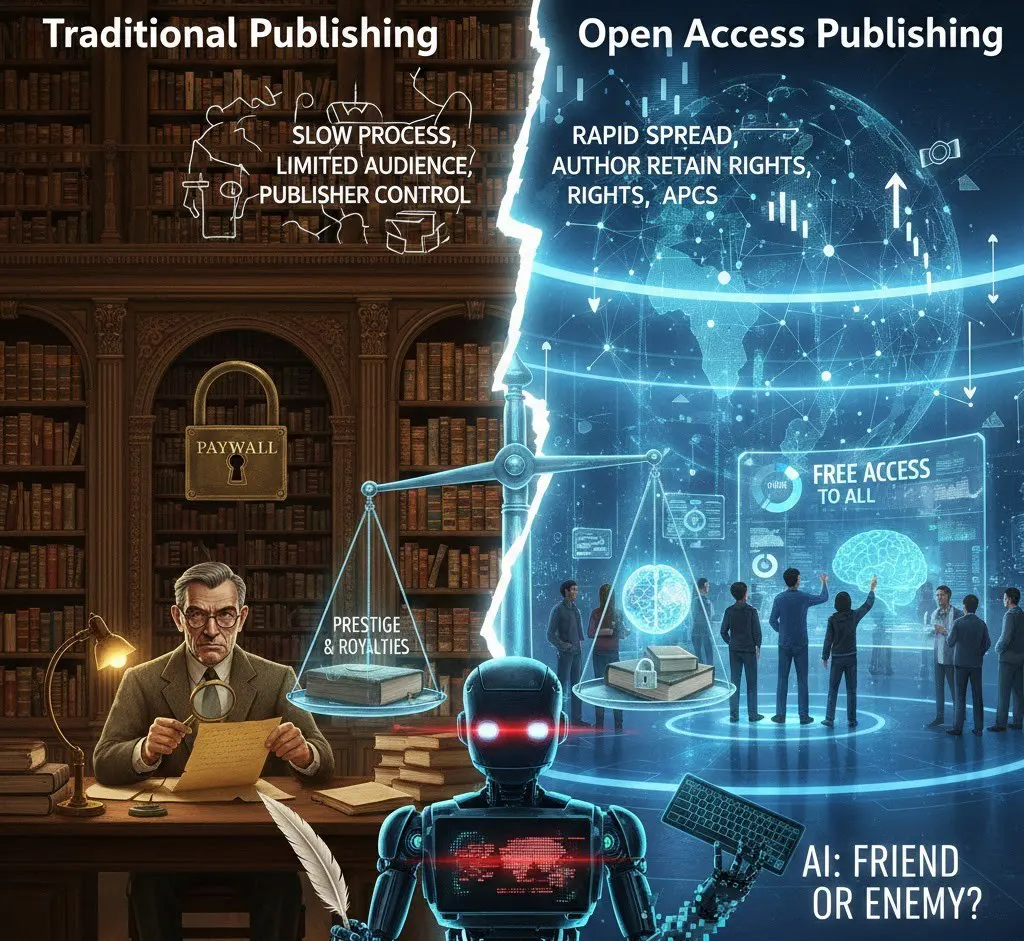
However, it brings its own set of problems. One of the rising concerns and enemies of the academic world is generative AI, which is growing across the sector. It acts like both enemy and friend.
The competition is rising day by day. Whereas the publishing matters now for researchers more than ever, the reason is that it openly commands the visibility, availability and effect of their work.
Though it is clear that obtaining your research publish play a huge role in publication. And it is vital for researchers to progress their careers. So, picking between open access and traditional publishing may seem confusing.
The debate between open access vs old-style publishing is a major, rising conflict for academics and researchers.
This is what I will talk about in the next section. Let’s move on to the article.
What is Traditional Publishing?
The process of traditional publishing, where an author works with a 3rd party publisher who takes up the liability of doing the main tasks. From editing to marketing to releasing to selling the book.
The authors mainly trade their work for network connections and publishing services. Being an author, if you use this method, you will lose all of the ownership of your work.
You will get less loyalty, like a small chunk.
How its Work?
The main process of traditional publishing is as follows.
- Write and polish- The first step of this journal publication begin from a manuscript (fiction) where authors write a quality one or a book proposal with sample chapters (nonfiction).
- Query agents- The majority of the big publishers like research and query literary agents, do not receive self-independent submissions.
- Sign representation- Authors normally obtain a 15% commission on sales by agents.
- Submission- In the step of submission, at the publication houses, the agent pitches your book to editors.
- The book deals-If the editor has an interest in the book, they decide on whether to buy the book or not by taking it to an acquisition meeting. Normally, they offer the contract to authors, and they also offer future advance royalties.
- Production- The publisher tackles all of the work from editing to cover design to printing.
- Marketing and launch- In the last step, when all of the work has been done, the publisher markets the book to retailers, libraries and consumers.
Key Features of Traditional Publishing
Here are some key features of a traditional publication.
- No upfront cost- There is no upfront cost; the publisher handles and bears all of the costs. From editing to design to marketing expenses.
- Advance royalties- The authors normally receive the future royalties, such as 10 to 15%.
- Lesser control- Authors have lesser control in decision making; the publishers have all of the control in the final decision.
- Longer period- The period is normally longer, at least 1 year, and in most of the cases, it takes 2 to 3 years to find the right publisher.
What is Open Access Publishing?
Open Access Publishing is a set of principles and methods; it is normally done via research outputs such as a peer review, journal articles and online access. These are mostly free of cost.
Any person can read these journals, download them, and share their work instantly after publication.
In order to cover editorial, peer review, production and archive costs, the majority of the OA journals charge APCs, article processing charges. It mostly happens after the paper is published.
Moreover, it reduces the financial, technical and legal barriers.
It removes financial, technical, or legal barriers,
How does the OA Publishing Work? and its Different Types
- Gold Open Access- All articles who publish via OA are quickly available to the wider audience. Whereas the authors or funders normally pay APS charges in order to cover the cost of publishing.
- Green Open Access- Authors normally publish in any journal, even the subscription based. However, they also need to submit a version of their papers. It is in the form of a preprint or postprint in a free and public source.
- Diamond or platinum open access- In this step, the publisher makes the journal open access. The good part is that they do not even charge authors or readers; it is normally backed by academic institutes or societies.
- Hybrid Open Access- It is basically a subscription-based journal; authors write a manuscript and also pay to openly access the
Key Differences Between Open Access and Traditional Publishing
Here are the main differences between OA and traditional publishing.
1. Access and Cost
While OA offer free access to readers. However, it normally requires authors to pay for the APCs. On the other hand, traditional publication uses the methods of paywalls, need subscriptions for readers.
2. Copyright and Licensing
Authors normally retain copyright in OA, and typically publish under Creative Commons licenses. But, in the traditional models, publishers normally have the right of copy.
3. Visibility and Impact
In contrast to traditional publication, OA articles have more visibility, are quicker, and have higher citation rates.
4. Speed of Publication
OA journals also have a quick turnaround time compared to traditional journals. And these journals normally have lengthier production cycles.
5. Prestige
One more difference between open access vs traditional publishing is that traditional settle journals normally hold higher prestige. And they have the huge impact factors.
6. Hybrid Choice
Now lot of traditional publication papers provide a hybrid method or model. These journals enable authors to charge a fee, and they make their individual papers accessible to everyone.
Advantages and Disadvantages
Pros and Cons of Traditional Publishing
Pros
- There is no direct cost to authors for publication
- It establishes reputation and credibility, mostly in journals that have a high impact, as well as notable book publishers.
- Settling normally have the severe peer review, and that increases the quality of the work.
- Authors who choose the traditional publication may obtain royalties.
Receive a Premium Quality Journal with the Help of an Experienced Writer
Worry about your quality of writing and stress out due to writer’s block? No issues with a skill and a Maven writer, you will not write an engaging and well-researched journal, but the writer will help you publish your work in a reliable journal
Connect Now!
Cons
- It has limited access because of the paywalls and limits to readership.
- Authors normally have no copyright access or distribution rights
- A longer publication takes plenty of time because of the extensive peer review and editorial practices.
Pros and Cons of Open Access
Pros:
- Boost the visibility and citation rates, because of the clear access
- For those who live in the low income regions, obtain the huge amounts of knowledge and broadcasting.
- Authors retain the copyright, and it enable for wider delivery and reuse of content
- OA has the ability to reach to the wider and huge audience far beyond the academic.
Cons:
- OA has possibly greater APCs, BPCs, or CPCs, and hence making it unavailable for few researchers.
- It varies in quality and peer review standards between OA publishers.
- Those who are greedy journals and publishers ruin the model, and they do not even keep the rigorous academic setting, only for the sake of their profit.
Which Model is Better for Researchers?
OA is ideally better for maximising the impact of the research, visibility, and citation rates. On the other side, traditional publication is best for prestige, prestige based career growth, and it does not offer higher fees.
The question is which model is perfect for the researchers. Well, there is no single model that is best. Once you choose the right one, as a researcher, here are the key factors you must consider.
- Audience- Who is your audience? You need to classify it? These can be specialists who work at reputable firms, or a wider global readership.
- Funder- Do you have OA directives or source requirements?
- Budget- Do you have the budget for APCs, or would you prefer a no-fee, subscription based journal to become more realistic?
- Journal quality and range- To conclude, you need to ask the question yourself. Is the journal reliable, indexed, and a suitable fit for your subject?
The Future of Academic Publishing
The future of academic publication is growing fast on the way to open access, AI-driven automation and research transparency. The only problem is that academic publishing faces traditional subscription based models.
Here are the rising future trends of scholarly publication.
1. Engaging Publications
There is a rising interest in creating academic papers mora and more engaging. This can comprise combining the elements of multimedia features, data visualizations and engaging figures to boost the reader’s knowledge.
2. Interdisciplinary Research Journals
Now, with the growing focus on cross functional research, there is a trend in the direction of the development of journals. And the aim of this journal is to close the gap among various fields of study.
3. Shift in Publishing Models
The subscription-based publishing method is now facing plenty of issues. A few publishers doing and conduct test with new models. Like publish and read agreements.
And institutes pay a sum to assist OA in publishing articles from their researchers.
4. Language Agnostic Platforms
These new interactive platforms that let and choose the authors to choose the broader audience may be an ideal option in the future.
This might be more preferable for imparting research findings in a more accessible language.
5. AI in Peer Review
In the field of publishing, AI tech such as NLP and ML might play a huge in the practice of peer review.
These techs can assist with plenty of key problems which authors face, like plagiarism detection and manuscript screening. And it will also help in the practice of review itself.
6. Open Access Movement
Now OA has become more famous and available. It also obtains more momentum compared to traditional publishing. A lot of funding firms and agencies are growing in support of OA.
They assist areas like research outputs, creating academic publications widely available for every person.
7. Print and Quick Publication
Preprints are initial versions of research papers, as they are shared prior to the formal peer review process. They have become more prominent.
Further, they enable the quick broadcasting of research findings. There are plenty of fields that have already accepted the preprints.
As a result, this trend will grow much more in the near future.
Future Challenges and Considerations
Here are some future challenges that traditional and academic publishing are facing
- Equity in Publishing- APCs for Open access raise some serious matters about financial obstacles for researchers.
- Academic honesty- In the area of AI keep the high standards of rigour is very difficult now. As the AI tools such as Chat GPT have the ability to write content within minutes. But it comprises the quality. It raises serious concerns for authors and researchers.
- New revenue models- The change from subscriptions is warning new read and publish agreements.
- Focus on diversity and inclusion-Now the emphasize on increasing in order to make sure diverse voices and a global image in publishing and editorial boards.
Ending Note:
Finally, OA and traditional publishing journals introduce separate methods to academic publishing.
Every method has its own set of benefits and drawbacks. There is no single one that is ideal; it all depends on the individual's preferences and needs.
OA offer increase availability, rapid broadcasting and increased teamwork. It lacks funding, quality control, and copyright issues.
Traditional journals, while offer establish reputations tough per review and a long lasting preservation. The problem is that it has an issue with restricted access, a slow process of publication and a problem with transparency.
Once you grasp these well, you will surely make a better choice, which is ideal for your publication.