Welcome To Journal Publishers UK

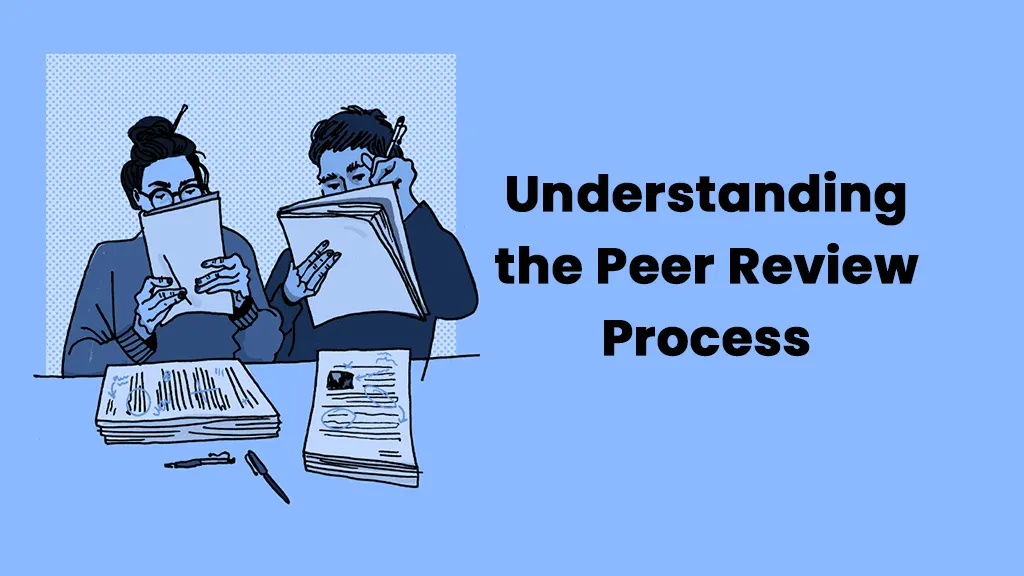
Understanding the Peer Review Process

Peer Review

Author: Emma Martin

The peer review is an essential feature of academic research and publishing. It serves as a quality mechanism for control.

Moreover, it makes sure that the academic articles follow the rigorous standards of accuracy, validity and significance.

Whereas the peer review is vital for keeping the honesty of the academic work. It is a daunting process for most scholarly authors.

These peer reviewers are usually drawn from a panel of independent experts. As they carefully examine, evaluate papers for quality and relevance.

In addition, academic articles analyse many factors methodology, transparency, and originality of the author’s work.

Hence, in this article, we delve into the difficulties of peer reviewers' practice. Also, we provide valuable insights and how many stages of peer reviews.

What is Peer Review, and Why is it Important?

Peer review, often known as refereeing, is the process of probing submissions to an academic publication.

On the other hand, a panel of reviewers in the same topic area uses precise criteria to choose whether to approve each proposal for publication.

As of the rigorous procedure required before publication, peer-reviewed publications are regarded as extremely dependable sources.

Further, the journal editors choose certified reviewers who examine the paper’s quality, validity and originality.

The practice of finalising peer reviewers can take months. And it also comprises of lot of revisions.

Here are the key aims of a peer review.

  • Quality assurance: Peer review guarantees that research publications satisfy high standards of accuracy, methodology, and ethics, which contributes to the solidity of academic and scientific literature.
  • Constructive criticism: Reviewers provide authors with useful criticism. This allows them to improve their work and fix any flaws or limitations.
  • Error Detection: Reviewers can detect flaws, variations, or holes in the study that the authors may have ignore.
  • Contribution to Knowledge: Reviewers evaluate the research's exclusivity and relevance, helping to increase knowledge in the field.

A diverse range of quality pre-submission peer review services is available if you need any help. Do not forget to reach out.

Significance of a Peer Review

Here are the key reasons why is peer review important.

  • Quality control- Peer reviews assist and maintain the supreme standards of quality. It removes flawed Hence, make sure that only rigorous and credible research is used.
  • Credibility and trust- The research of the peer reviews journals is often consider reliable. Moreover, this kind of credibility is essential for impacting policy, practice and more research.
  • Positive feedback- Reviewers each time offer feedback to authors and valuable support every time. As a result, this helps them improve the quality of their work.

Different Stages of a Peer Review

Here are the steps of peer reviews. If you need any help, obtain support from expert manuscript reviewers. They will help you with your papers.

  1. Firstly, the researcher sends their article to a potential journal.
  2. Then the journal's editorial board reviews it to decide whether the study is pertinent to the publication.
  3. Depending on how the editor's evaluation proceeds, the journal may offer three choices.
    1. Accept the article, which is afterwards submitted for expert evaluation.
    2.Reject the paper with the option to resubmit once the researcher has made revisions.
    3. Reject the paper totally.
  4. If your work is approve, it will go through a peer review process, which typically includes one to three experts in your field.
  5. Depending on how the research was reviewed, you may need to rewrite your work.
  6. Once the changes have been approved, your manuscript is ready for publishing.

Top Future Trends in Peer Review

The top peer reviews futures such as AI assisted review and hybrid review. These are the rising trends, and in the next section, I will explore them both.

1. AI Assisted Peer Review

The use of AI tools can assist to automate and simplify some portions of the process. These include finding potential reviewers, detect the plagiarism, and gauging the quality and efficacy of research.

Also, AI can assist to decrease human biases and conflicts in peer review, resulting in a more objective and reliable valuation of scientific work.

2. Hybrid Peer Review Models

There will likely be an increase in hybrid models that combine elements of several peer review systems.

For example, a journal may employ open peer reviews for certain papers. But standard blind review for others.

As a result, the technique is chosen as per with the research's unique requirements.

What Does a Reviewer Do During Peer Review?

Here are the main features of good reviewers and the peer review process as follows.

  • They are Timely-They create safe time mostly for the review the manuscripts. Then they wisely follow any deadlines assign by their journal. The reason is that they are familiar with the timely reviews.
  • Their focus on the schedule stands Good reviewers are cautious. They always take the time to offer a detailed evaluation of even a short submission. Also, they offer support if the paper is not accepted. A good reviewer always reads the guidelines wisely and follows them from the journals.

Tips for Navigating the Author's Peer Review

Choose the Right Journal: Firstly, you need to select the right journal that is relevant to your study topic. Also, it must meet the quality requirements you aim to achieve.

Follow Submission criteria: Now you need to avoid the initial rejections. And obey the journal's formatting and submission criteria.

Prepare for Feedback: You must respond to reviewer remarks with an open mind. Further, a positive criticism may be quite useful for enhancing your study.

Respond Kindly: When editing your manuscript, carefully consider all reviewer remarks. Clearly describe how you carry out their advice or why you did not.

Final Thought

Hence, we finish our guide, always recall that navigating the process of peer review can be tough. But if you grasp its essentials and system, the process becomes easy for you.

Peer reviews are a vital part of academic research and publishing. So, once you follow our helpful guide, you can easily navigate the process.

Emma Martin

Emma is our highly skilled editor with over five years of professional background in a University press. She holds a Master’s degree in a scientific discipline and has been associated with the agency for two years, where she polishes drafts using her peer review expertise and comprehensive understanding of open access and traditional publishing standards.

Publication Problems? Talk to Experts Now!

journalpublishers.co.uk is a leading platform in the UK for peer review services, journal publishing and editing support, helping researchers publish in top journals like Scopus, PubMed and IEEE. With a team of experienced professionals, we are the go-to choice for the researchers looking for help. Hire us now!

©Copyright 2025 journalpublishers.co.uk Rights Reserved

Journal Publisher Rated 4.8/5 based on 5768 Reviews