info@journalpublishers.co.uk
 +44 746 075 1919

Writing has been a formidable means of recording ideas, articulating feelings, and holding knowledge. Ongoing contemporary research continues to show its worth in schools, professional development, and personal wellbeing.
Journaling techniques can help you make sense of random ideas, boost your grades, sharpen your creativity, or increase your emotional awareness.
Students rely on journals for developing critical thinking skills; professionals take notes during projects; researchers make observational notes; authors establish regular writing patterns that influence the creation of future books.
No matter your objective, you'll gain an advantage from a sustainable, beneficial journaling routine that extends beyond the page.
What is Journaling?
Journaling is the habit of regularly writing down thoughts, experiences, observations, knowledge, or personal reflections. Journal writing is not like a formal report or an academic essay, but it offers more freedom of writing while still maintaining logical organization.
The following features may be included in a journal:
- Daily experiences
- Personal reflections
- Academic notes
- Research observations
- Project planning
- Goal tracking
- Creative writing ideas
- Professional development records
- Reading notes
- Gratitude entries
This versatility is what makes journal writing so relevant in schools, universities, workplaces,s and the creative industries.
The American Psychological Association has found that regular expressive writing can, over time, improve emotional processing and reduce stress. In a separate study, researchers at the University of Rochester Medical Center found that journaling improves emotional health, problem-solving, and self-awareness.
Frequent writing helps reinforce memory and promotes active recall rather than passive reading. Reflective writing has long been associated with better understanding and long-lasting learning in educational psychology.
Journal Techniques
Each journal has a specific function. Some relate to everyday situations, some to research findings, creative ideas, long-term objectives, or emotional thoughts. There is no single right way to journal – it depends on what you're looking to gain.
Consistency, honesty, and organized thinking are promoted through effective journaling. Good journal writers create a basic plan that allows ideas to unfold over time, rather than trying to write long entries without one.
Why Do Different Journalling Techniques Create Different Results?
Many newbies think journaling is just writing what comes to their mind. The free writing can be useful, but structured approaches can yield more profound insights.
Different situations require different solutions. For example:
- Reflective learning records are useful for a student preparing to take university exams.
- Progress logs and weekly reviews are more valuable to a project manager.
- Before writing a novel, an author can make character journals, plot outlines, and brainstorming pages.
- A researcher makes systematic observations to ensure accuracy during the study.
With the right technique, journaling is not just random writing but purposeful thinking.
Different Ways to Journal
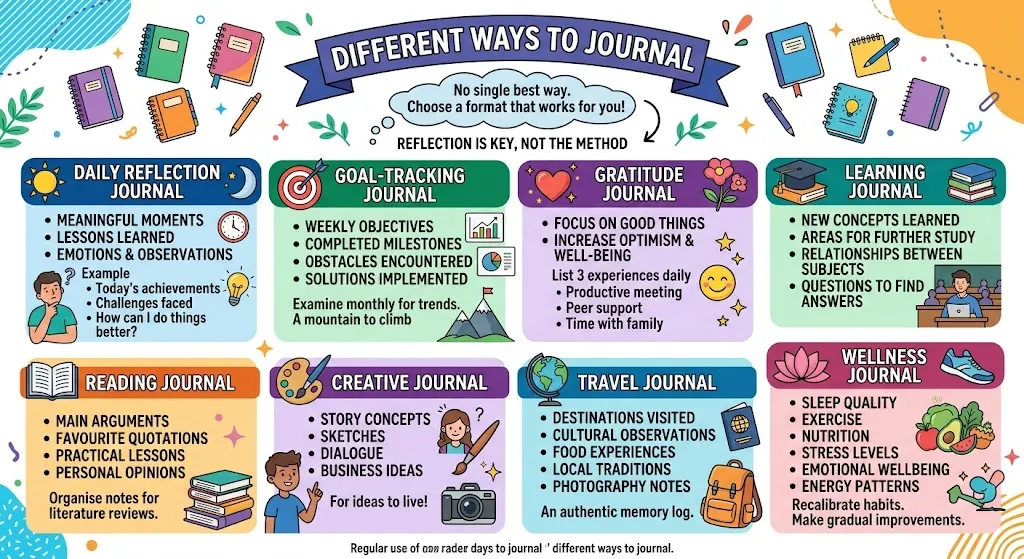
There is no single best way to journal. There are many ways to use a storyboard, from planning a new book to creating one for a movie.
Trying out various formats of journals will help you decide to adopt a journal format that will facilitate your goals rather than making you feel constrained.
The most successful journal will be the one that you will use regularly. The point here is that the process of reflection is important, not the method used to take notes.
1. Daily Reflection Journal
Keeping a daily reflection journal of meaningful moments, lessons, emotions, and observations. Reflective entries ask, "why," "what did you learn," and "how can things be done better in the future," which helps you to think more deeply than a simple diary entry.
For a simple day-to-day routine, you could consider:
- Today's achievements
- Challenges faced
- Lessons learned
- Today, I will be making one thing better. I will make one thing better tomorrow.
- A good positive action to remember!
The 10-minute daily practice of this exercise reinforces self-awareness and makes a great log of personal development.
2. Goal-Tracking Journal
If goals aren't measured regularly, they tend to go unmet. A goal journal helps to make dreams a reality.
Here are the entries that you can make:
- Weekly objectives
- Completed milestones
- Obstacles encountered
- Solutions implemented
These entries should be examined monthly, as they reveal patterns and trends that may help explain why goals can be achieved or blocked.
3. Gratitude Journal
Gratitude journaling gets you to think about all the good things, instead of all the things that are driving you crazy. Those who wrote about their gratitude experienced higher levels of optimism and wellbeing, according to a study published in the Journal of Personality and Social Psychology, which examined people's gratitude writing.
Instead of using paragraphs, make a list of three significant experiences each day, like
- A productive meeting
- Support from a peer colleague
- Completing an assignment
- Acquiring the skill.
- Having fun with the family
This practice helps rewire the brain to focus not just on failures, but on success as well.
4. Learning Journal
Learning journals are becoming more popular in colleges and universities throughout the UK as a way to review information learned in class.
They think about rather than copying notes from the lecture:
- New concepts learned
- For further study areas, see the following:
- Relationships between other subjects
- Questions to find the answers to later
5. Reading Journal
A reading journal is a tool for capturing essential ideas and promoting critical thinking. Each book entry may include any combination of:
- Main arguments
- Favourite quotations
- Practical lessons
- Questions raised
- Personal opinions
- Applications for working or studying
Reading journals is helpful for many postgraduate students when writing journal manuscripts, as it helps them organize notes for literature reviews.
6. Creative Journal
Creative journals have a place for ideas to live before they're lost. Frequently recorded by artists, designers, marketers, and authors alike, here is what the creative journal includes:
- Story concepts
- Character profiles
- Marketing slogans
- Poetry
- Sketches
- Dialogue
- Business ideas
The majority of best-selling books start as a collection of journal entries over a few months. Furthermore, there is an option to start creative journaling for academic writers, which allows them to jot down their research, take effective notes, and write research papers.
7. Travel Journal
When traveling, you will have some experiences that are very memorable but will quickly be forgotten if you do not document them.
The travel journal should have:
- Destinations visited
- Cultural observations
- Food experiences
- Local traditions
- Personal reflections
- Photography notes
- Budget tracking
Private travel journals allow for authentic introspection, unlike subsequent social media posts.
8. Wellness Journal
Health is not just about being physically fit!
A wellness journal documents:
- Sleep quality
- Exercise
- Nutrition
- Stress levels
- Emotional wellbeing
- Energy patterns
Habits can be recalibrated after a few weeks, and it's possible to make gradual improvements in the lifestyle.
Types of Journaling Methods You Can Try!
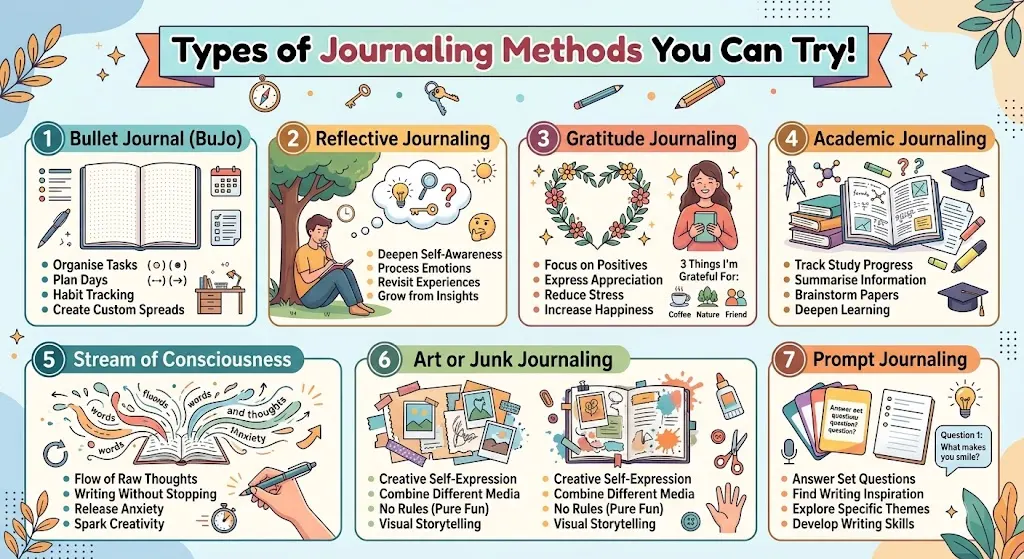
Trying out some different journaling styles can help you discover a way to write that is easy for you and helps maintain your daily writing routine.
Here are some of the most popular journaling techniques and the ways they can help you in your personal, academic, and professional life.
- Bullet Journal: It's perfect for organization and maximizing productivity as it organizes tasks, appointments, and long-term goals using bullet points, symbols, and habit trackers.
- Reflective Journaling: Prompts reflection on experiences, feelings, and insights gained from a situation, as opposed to just a description of what happened. It is very popular for reflective journaling for research purposes, where students and researchers can record observations, review results, and monitor thinking processes.
- Gratitude Journaling: Writing three to five things that you are grateful for every day. This is a simple practice that will help develop a positive attitude, lower stress levels,s and increase your appreciation of everyday things.
- Academic Journaling: Supports students and researchers in structuring lecture notes, reading summaries, research development, and learning reflections. Key academic journaling benefits include better critical thinking, more effective knowledge retention, better assignment planning, and improved manuscript writing.
- Stream of Consciousness (Morning Pages): A set of two or three pages of writing without editing or organising your thoughts. This technique helps to get rid of anxiety, eliminate overthinking, and often bring new ideas to the surface.
- Art or Junk Journaling: Mixes written reflections with some visuals like a sketch, photo, magazine cut-outs, stickers, tickets, or pressed flowers. Great for creative expression and to keep meaningful moments.
- Prompt Journaling: To use thought-provoking questions or writing prompts to guide your writing in your journal. This is particularly useful if you don't know what to write about or if you need to cover a topic in more detail.
How to Journal Effectively?
Lots of people think longer journal entries will lead to better results. It's not about the quantity but the quality.
There are four basic principles of good journal writing, which include;
1. Write honestly: Don't write what sounds fancy. Meaningful records are made through honest observations.
2. Stay consistent: It's better to write three times a week than twenty pages once a month.
3. Describe in Detail: Describe rather than reflect, as it t helps to record events.
4. Work on your experiences: Analysing experiences is transformational. Instead of writing:
For example: Instead of saying, The presentation today was good.
Expand it.
I rehearsed the presentation beforehand and broke down the difficult slides, so I am glad it went well today, but I will leave more time for questions from the audience next time.
Reflection is the process of converting experiences into improvements for the future.
5. Review previous entries: Weekly reviews give an overview of recurring behaviours that individual entries don't show.
Journaling is a tool that can help you find clarity in your thoughts and feelings. Too many ideas can be a problem for productivity, as they tend to overwhelm the mind.
Journaling Methods for Mental Clarity
Writing helps to put distance between you and the overwhelming thoughts. There are several effective journaling techniques to help with clarity of mind:
- Brain dump: Record all ideas in any order. Afterwards, group similar ideas together.
- Priority list: Prioritize urgent tasks and important long-term goals.
- Problem-solving journal: Define the challenge, list possible solutions, evaluate likely outcomes, and choose one action.
Frequently, breaking down complex situations into smaller steps in writing will help to lower stress and enhance decision-making.
Studies from the University of Texas at Austin with expressive writing indicate that structured emotional writing is effective for people to organize thoughts and to work more effectively through stressful experiences.
Mindful Journaling Techniques
Mindfulness promotes non-judgmental awareness. Furthermore, it is enhanced by journaling, which cultivates emotional balance and focus.
Some helpful mindful journaling techniques are:
1. Breathing reflection: Write within 5 minutes of concentrated breathing. Be aware of any emotions that may occur, both prior to and following writing.
2. Sensory awareness: Describe:
- What you see
- What you hear
- What you smell
- Physical sensations
- Emotional responses
This is a simple exercise to remind ourselves about being in the present moment.
3. Emotion labelling: Rather than saying, "I felt bad," use a specific word for how you feel:
- Frustrated
- Disappointed
- Excited
- Nervous
- Grateful
- Confident
Specific language generates higher emotional sensitivity than general descriptions.
Professional Journaling Practices
Journals are used by people in all professions to enhance decision-making, review others' performance, and record the lessons a team learns during a project. Professional journals differ from minutes or formal reports and focus more on personal observations that can inform future action.
Most project managers, marketers, researchers, healthcare practitioners, educators, and business leaders keep journals to track progress and identify trends. After important tasks, you need to record the experience as soon as possible, so you do not forget the details.
Here are some professional journaling practices:
- Weekly achievements
- Project milestones
- Client feedback
- Challenges encountered
- Solutions implemented
- Skills developed
- Training completed
- Future objectives
These entries will be useful as a record of career development if read monthly. It is also useful when performing an assessment, job interview, or promotion interview, since achievements are recorded and not remembered.
How to Journal for Productivity?
Productivity journals are not a diary. They are meant to be used. Here is how you can journal for productivity.
1. Morning Planning
- Three priorities
- Meetings
- Deadlines
- Important reminders
2. Evening Review
- Completed tasks
- Unexpected interruptions
- Lessons learned
- Tomorrow's priorities
After a few months, revisit productivity journals to see common distractions and patterns that support productivity. Many experts use productivity journals alongside digital calendars for maximum organisation.
Structured Journal Writing Guide
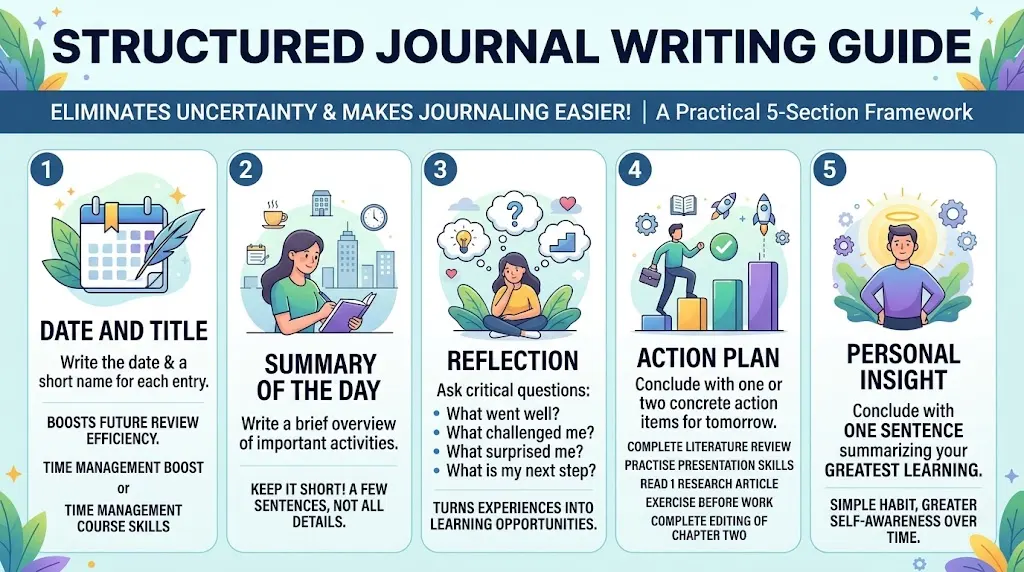
Structured format eliminates uncertainty and makes journaling easier to keep up with. You don't have to think about what to write every day; you just have a framework to follow.
There are five sections to a practical journal entry.
1. Date and Title
Write the date and a short name for each entry. This will make future reviews much easier.
Example
You can boost your time management skills with this course. This course will help you enhance your time management skills.
2. Summary of the Day
Write a brief overview of important activities. Only write a few sentences in this section; do not describe all the details.
3. Reflection
Here are some questions to ask yourself:
- What went well?
- What challenged me?
- What surprised me?
- What was my next step?
Reflection is the process of turning experiences into learning opportunities.
4. Action Plan
Conclude each entry with one or two action items.
Examples include:
- Tomorrow, the literature review will be completed.
- Practise presentation skills.
- Read 1 research article.
- Exercise before work.
- Complete editing of Chapter Two.
5. Personal Insight
Conclude with one sentence summarizing your greatest learning of the day. This is a very simple habit that creates greater self-awareness over time.
Examples of Journaling
Examples of journal writing will help you in learning how to write your own. Each journal entry will be for a different purpose, and one format is not required.
Example 1: Academic Reflection
In the seminar today, I learnt about the process of thematic analysis and how my previous approach to coding my analysis was not systematic. I will be changing my coding system for the analysis and comparing my coding system with two published journal articles before next week's class.
Example 2: Productivity Journal
Today's priorities
- Complete client proposal
- Edit website content
- Attend the project meeting
Achievements
Completed work at an earlier-than-expected deadline.
Improvement
Minimize checking email during "Focus Time.
Example 3: Gratitude Entry
Today I'm grateful for:
- Positive comments by my supervisor.
- Reading completion.
- After-work family activities.
Example 4: Research Journal
A participant in the interview shared an unexpected perspective on digital learning; consider follow-up questions for future interviews to explore online collaboration.
Example 5: Creative Writing Journal
Interesting novel idea: A historian finds handwritten journals that change historical events as they are opened.
Here are a few quick examples of journal writing that illustrate that journal writing does not have to be a lengthy essay. Remember, quality is more important than quantity.
Journaling for Beginners
One of the most common reasons beginners end their writing careers is that they run out of ideas. Hence, always look for the journaling prompts rather than the descriptions;
Here are some journaling ideas for beginners.
- Three achievements this week.
- A blunder that had a valuable lesson for me.
- The most important thing you want to accomplish this month
- A talk or a realization that altered your viewpoint.
- A book that impacted your thinking.A book that has shaped your thinking.
- Skills you'd like to enhance
- On the other hand, here are five things you're thankful for.
- Your perfect morning routine
- An illustration of a problem you solved recently and the solution you took.
- One habit you would like to acquire
- Tell about the most joyous memory of your childhood.
- Write a composition about someone who has influenced you and why.
- Write down five personal strengths that you are proud of.
- How would you define success?
- Write a description of your perfect day from beginning to end.
- Write a letter to the future you.
- Remind yourself of an obstacle you have managed in the past.
- What are the 5 most important goals you have in life?
- Write about a place where you feel like you are at ease 100% of the time.
- Write about something you're afraid of that you'd like to get over.
- Write down 10 things that make you smile.
- What is your driving force for continuing to make progress?
- Look back at a mistake you made recently and what you learned from it.
- Explain your career aspirations and how they interest you.
- Write a book report about the book you love and what the greatest lesson you learnt from it was.
- What are some healthy habits that you would like to incorporate?
- Write about someone who has made a great difference in your life.
- If you had an extra hour per day, what would you do?
- Tell about something you have recently done well in your life that you are proud of.
- List 5 characteristics you like in people.
- Share your number one priority in the next 5 years.
- What would you consider to be the mark of a happy life?
- Discuss a challenging choice you had to make.
- Think about a compliment that you'll never forget.
- What are three new skills you'd like to learn this year?
- Talk about what you would like to do on your ideal weekend.
- Describe an experience in which you were outside of your comfort zone.
- What does the work-life balance mean to you?
- List your favourite ways to relax after a busy day.
- Write about your favourite place to travel or where you would like to travel.
- What values are you guided by at the individual level?
- Write a letter of thanks to someone who has made a difference to you and explain why.
- Talk about a good habit that has helped you in your life.
- What would you envision your ideal workspace to be like?
- Write a description of a memorable lesson at school or university.
- Challenge yourself to think of five minor successes you accomplished this month.
- What do you love about yourself?
- Describe a time when you helped someone.
- If you were ten years younger, what would you say to yourself?
- Write a paragraph about your favourite season and why you like it.
- Think about a time when you had a different viewpoint challenged recently.
- Write a list of 10 things you'd like to do before the end of the year.
- Explain the greatest motivator for you.
- What is your favorite self-care activity?
- Describe a new hobby you would like to have.
- Write about something you're really proud of that you've accomplished to date.
- What is your definition of a successful career?
- Write a description of a tradition that means a lot to you!
- Remember a lesson learnt from a recent conversation.
- Conclude today's journal by making 3 self-affirmations—things you ought to be proud of.
Furthermore, you can repeat these prompts regularly to track progress over time.
How to Journal Daily?
Journaling every day doesn't need to be an hour of writing. Little and frequent is better than one big session every so often.
Here are some examples of a simple daily routine:
Morning
- Set three priorities.
- Write one motivational sentence.
- Determine the largest task.
Evening
- Record accomplishments.
- Reflect on challenges.
- Record 1 learning.
- Plan tomorrow's priorities.
If you journal right after your morning meal or when you go to bed at night, it will help make the practice second nature.
Begin Your Journaling Adventure Now!
It doesn't take much fancy software or amazing writing skills to start a journal. It only takes a notebook, a digital document, or a note-taking application to get started.
- Choose one purpose.
- Write consistently.
- Reflect honestly.
- Routinely assess your progress.
The notes you make over the course of a day add up to a priceless record of ideas, accomplishments, difficulties, and progress.
When you want to write an ebook, research paper, or get into book publishing, journaling offers an organised base for you to build on when handling greater writing projects.
Ready to turn your journal into meaningful research?
Whether you are documenting research findings, reflecting on your progress or organising ideas for your next project, consistent formatting can strengthen your writing. Connect with the professionals who can help you with research writing, journal preparation or academic publishing.
Start Your Academic Journey!
Frequently Asked Questions
1. What are the effective journal writing strategies?
There are set methods for writing, known as journaling techniques, that can be used to organise thinking, reflect on experiences, monitor goals, enhance learning, and promote emotional wellbeing.
2. How to start a journal?
Set a clear purpose, begin writing consistently with short, honest entries, and choose a notebook or digital app.
3. How to begin a journal?
For good results, begin by doing 5-10 minutes a day. Select one topic; compose honestly without concern for grammar or perfection.
4. How many times a day should I write in my journal?
It's good to write every day, but three to five sessions per week would also give it a purposeful impact if it's a habit.
5. Is journaling a means to improve academic performance?
Yes. Students use reflective writing to enhance their critical thinking skills, knowledge retention, and to structure their research.
6. Paper or Digital Journal: Which is best for journaling?
Either of these options is appropriate. Select any format that will be conducive to regular writing and will be the easiest to follow.
7. What to write in a journal?
Write about what you're doing each day, your goals, what you learned, your research, what you are grateful for, creative ideas, or personal reflections.
8. How many words should be in a journal entry?
While a few carefully crafted paragraphs can be of great value, most entries are between 150 and 300 words.
9. Do professionals need to journal?
Absolutely. Professionals keep journals to document projects, experience, lessons learned, and to aid career development.
10. Is journaling useful for stress reduction?
Expressive writing has been shown to be effective in helping many people manage stress, organize their thoughts, and process emotions.
11. How to write a journal?
The most effective way is the one that fits your objectives and is a habit you will form. Try different strategies until you find one that feels natural to you.